PerfectTransitions CS 175: Project in AI
Presentation Video
Project Summary
This project focuses on creating a seamless music transition model that predicts the best next segment of a song based on learned embeddings. The goal is to generate seamless transitions between music clips without abrupt changes as if there was never a change in music.
The approach consists of three main components:
- Feature Extraction: Using BEATs Iteration 3 (a Transformer-based model for audio understanding) to extract time-step embeddings from songs.
- LSTM Training: A Bidirectional LSTM trained with contrastive triplet loss, ensuring that the model learns to smoothly transition between music segments.
- Transition Matching: Computing cosine similarity between embeddings to predict the best transition point between songs.
The dataset consists of full-length songs (from the FMA dataset), which are preprocessed by segmenting them into 20-30 second clips with overlapping context to preserve musical continuity. The final goal is to deploy this model for automatic DJing, playlist blending, and AI-generated song transitions.
Approach
The goal is to create a seamless transition between two songs, as if they were part of the same piece. To create such a transition, we must identify a song whose beginning complements the ending of the previous song, making them sound unified.
1. Feature Extraction Using BEATs Iteration 3
Music data are highly complex and has a high-dimensional feature space, it includes multiple features such as timbre, tone, tempo, mood, key, progression scale, and etc…
In order to simplify the high-dimensional feature space and extract data that are easier to process, we used embedding to reduce the dimensionality while preserving the essential characteristics of the music.
We use BEATs-Large (Iteration 3, AS2M model) to extract per-frame embeddings from segmented audio clips. BEATs pre-trained model performs exceptionally well at capturing musical features such as rhythm, melody, harmony, and timbre. Which allow us to accurately captures the key characterstics of music data while lowering the complexity.
- Songs are resampled to 16 kHz and converted to mono.
- BEATs extracts embeddings at each time-step (T × D format).
- L2-normalization is applied before passing embeddings to the LSTM.
- Data is stored in
.npyformat for fast retrieval.
We used the open FMA database which contains 106,574 untrimmed tracks with 161 unbalanced genres of music. Due to overwhelming data size, We first trained the model on about 1% of the total data then increase the data size as we proceed further into development process.
Implementation Steps:
- Songs are cut into overlapping 20-30 second segments (default: 25s clips, 5s overlap).
- Segments are named sequentially to maintain their ordering.
- Embeddings are extracted and stored in /NFS/dataset/embeddings/.
- A checkpointing system ensures the process resumes from where it left off if interrupted.
2. Training the LSTM for Transition Prediction
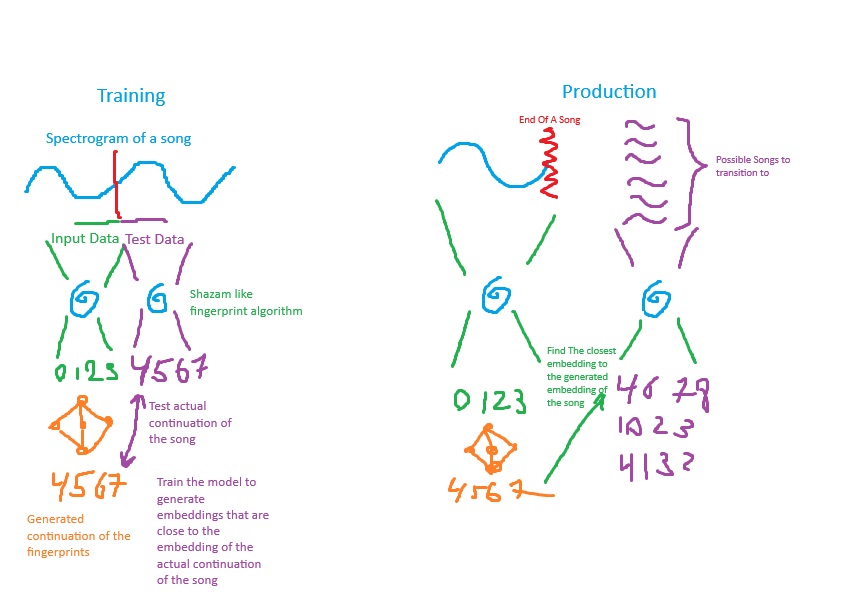
To achieve a seamless transition, we need to determine what group of songs, when paired with the ending of the previous track, will blend seamlessly.
To address this challenge, we decided to train an AI model that predicts how a song will continue based on a given section. We adopted the Long Short-Term Memory (LSTM) model to train on music/audio data, enabling it to forecast the continuation of input audio clips.
LSTM was chosen because music is composed of notes and sequences, and to capture the musical flow, we need a model that recognizes patterns and allow past inputs to influence the current output.
Given a segment of song, we split it into two parts. We feed the first part into the model and calculate the loss by comparing the model’s output with the second part of the file. This process compares the model’s predicted continuation to the actual continuation, giving us a loss function to optimize the model.
We train a Bidirectional LSTM with contrastive triplet loss to predict the most seamless transition between song clips.
- Two-Stage Embeddings: The end of one segment (A) is matched with the start of another segment (B).
- Triplet Loss Objective: \(\mathcal{L}_{triplet} = max(0, d(A,B) - d(A,C) + margin)\) where (A, B, C) is a triplet of (anchor, positive, negative) clips.
- Exponential Weighting:
- The last 3-5s of segment A and the first 3-5s of segment B are given higher weight to prioritize smooth transitions.
- Hyperparameters:
- Hidden Units: 128
- Layers: 2-3
- Dropout: 0.2
- Loss Margin: 0.2-0.4
- Batch Size: 32
- Optimizer: Adam
- Learning Rate Schedule: Cosine Annealing
Training is performed on SLURM using GPU nodes, with checkpointing enabled for preemption handling.
3. Transition Matching & Deployment
After training, the model will take a clip’s final embedding and produce the predicted continuing segment. Then the model will use FAISS(Facebook AI Similarity Search) to find the nearest neighbor of the predicted continuing segment in vector space. In this case, it will find the song that matches the most closely with the model predicted continuing segment. ONNX & PyTorch JIT are explored for fast inference deployment.
- The model takes a clip’s final embedding and finds the best next segment.
- FAISS (Facebook AI Similarity Search) is used for efficient retrieval.
- ONNX & PyTorch JIT are explored for fast inference deployment.
4. Evaluation Metrics
We evaluate both perceptual and mathematical similarity metrics:
- Spectral Convergence & Mel-Spectrogram MSE: Measures audio continuity.
- Cosine Similarity & Triplet Loss: Evaluates embedding consistency.
- User Listening Tests: Collect subjective ratings of transition quality.
Evaluation
There has been a change in evaluation method from the proposal. We originally meant to use different features of the music such as tempo, mood, and progression as metrics for quantitative evaluation. However, as mentioned previously, we utilize the BEATs pre-trained model to embed the audio data, so we will be evaluating using the embedded data instead of the higher dimensional music features.
We assess both quantitative model accuracy and qualitative smoothness of music transitions in following ways:
Quantitative Evaluation
- Triplet Loss Curve: Monitor the triplet loss throughout the training process to show how the model performance as the training progresses. We wish to see a smooth decreasing curve with no erratic fluctuation which suggest the training is effective.
- Cosine Similarity Distribution: Analyze the distribution of cosine similarity scores between “correctly” paired song segments and “incorrectly” paired ones. We can evaluate how well the model is at recognizing good transitions and the bad transitions. A working model should show a clear separation, with higher similarity for “correct” transitions and lower similarity for “incorrect” transitions.
- LSTM Loss Convergence: Observe the loss curve for the LSTM-based model over successive training iterations to ensure it is steadily decreasing. If trained correctly, the model should show a consistent decrease in loss, indicating that it is effectively learning the pattern of a song and predicting the continuation based on past inputs.
Evaluation
- Random vs. Learned Transitions: Evaluate the performance of our model by comparing model’s predicted transition against randomly shuffled segments which serves as our baseline. We hope the model will at least out-perform randomly chosen clips to prove that our model do provide a practical improvement when picking songs to transition to.
- Spectrogram Alignment: Assess the continuity of transitions in the frequency domain by comparing spectrograms or Fourier-Transforms before and after the predicted transition point. We want our model’s to generate a transition that maintains the previous song’s musical characteristics, ensuring there is no abrupt changes in timbre, energy, and etc…
- Listening Study: Conduct a user study where participants listen to transitions generated by the model and rate them based on how seamless or disjointed they sound. This evaluation method will provide the most realistic validation on our model’s performance by asking humans to directly judge the musicality of the transition.
All evaluations are logged in Weights & Biases (W&B) for experiment tracking.
Remaining Goals and Challenges
Our model did run into a performance failure at the current state. After the model is trained, we measured its performance to discovered its training loss, validation loss, and test loss is always around 30%. It does not converge to 30% but rather the errors has stayed 30% during the entire training process. Which led us to suspect no meaningful training has been done.
Possible Causes
Anchor and Positive Overlap Too Much
- During our research phase, we discovered it was recommended to make the music segments have a small overlap during training which will make the training easier. However, our chosen overlap size might be too large, which will cause the embedding of music segments to be very similar if not identical, making it difficult for the model to learn any meaningful distinction during training.
Negative Sample Is Too Similar to Anchor
- During training, we split a segment into 2 halves, we use the first halves as the anchor to train the model to produce second halves. We feed the model two types of segment for second halves, positive segment which is the second halves of the original segment, and negative segment which are randomly chosen second halves to represent bad transition. However, the negative segment might not be “bad” enough for our model to meaningfully learn what is a bad transition.
Empty or Tiny Arrays in Embeddings
- There occurs to be some embeddings that are too small or empty due to missing data or incorrect processing. Which led to the nearest neighbor distance calculation always results in 0, making the loss computation meaningless.
Small Dataset or Reusing an Old Checkpoint
- Due to the overwhelmingly large data set size, we decided to train our model using only 1% of the data so it can be processed and trained in a reasonable amount of time. However, it occurs that our data size is too small so the training started from an already saturated checkpoint, which led to the model be stuck in a local minimum of 30% loss.
Future Improvements
Other than fixing problems that are presented above, there are also some other improvements we can make on our basic model.
Two-Stage Embedding (Separate Start & End)
- Optimize embedding separation for better sequence learning.
Predicting Next Music Segment for Seamless Transitions
- Introduce a diffusion model for transition refinement.
Optimizing Crossfade Durations to Find the Best Seamless Song Transition
- Fine-tune the best fade-in/fade-out durations for seamless audio blending.
Interactive Interface
- Create a demo UI to visualize transitions and allow user feedback.
Music App Integration
- Test deployment into Spotify/YouTube DJ playlists or local audio mixing software.
Resources Used
Research Papers & Code
- BEATs Transformer Model (Microsoft UniLM):
- GitHub
- Pre-trained Checkpoints: BEATs Iteration 3 AS2M
- Triplet Loss:
- Hoffer & Ailon (2015): “Deep Metric Learning Using Triplet Network”
- Faiss: Facebook AI Similarity Search
- [Shazam Music Processing Fingerprinting and Recognition] (https://www.toptal.com/algorithms/shazam-it-music-processing-fingerprinting-and-recognition)
Libraries & Tools
- Torch + Torchaudio (Feature extraction, LSTM training)
- FAISS (Fast similarity retrieval)
- ONNX, PyTorch JIT (Optimized inference)
- SLURM + HPC Cluster (Model training)
- Weights & Biases (W&B) (Experiment logging)
Infrastructure
- Dataset: FMA (Full-Sized Songs)
- Cluster: Nvidia A100 & V100 GPUs, 100Gb/s InfiniBand